P2P VPNs Explained: How Decentralized VPNs Work and When to Use Them
Peer-to-peer virtual private networks are becoming more common as file-sharing grows. They also help rebuild confidence in P2P systems by adding layered privacy and security features.
So, how do P2P VPNs operate and how do they compare with standard VPN services? Keep reading to get a clear overview of P2P VPNs.
What is a P2P connection?
Before diving into P2P VPNs, it helps to know what a P2P link is. A peer-to-peer connection is a distributed arrangement where machines, called peers, talk directly to one another instead of relaying everything through a central host.
Every peer can contribute things like files, upload/download capacity, or compute cycles, which makes P2P systems robust, scalable, and often cheaper to run.
Here are several typical P2P use cases:
- File sharing (torrenting): People exchange large files directly without a single central server handling distribution.
- Decentralized streaming: Viewers receive video from multiple peers to reduce demand on origin servers.
- Real-time communication: Peer-hosted voice and video calls connect participants without always relying on relay infrastructure.
- Online gaming: Multiplayer sessions can use direct peer links or host-to-host connections.
- Content distribution/CDN offload: Sites and apps use peers to cache and serve content to reduce server load.
- Distributed storage and backup: Files are split and stored across many participant nodes for redundancy.
- dApps and blockchain: Decentralized applications and cryptocurrencies run on peer networks rather than centralized servers.
- Mesh networking: Devices form local networks by connecting directly to each other.
What is a P2P VPN?

A P2P VPN is a VPN variant that leverages peer-to-peer technology to create encrypted, peer-based links between devices. That design often cuts down on centralized bottlenecks and can make sharing large files smoother. It also encrypts sensitive information, including your Internet Protocol (IP) address, while peers exchange data.
P2P VPNs are sometimes called dVPNs (decentralized VPNs) because they run on distributed peer networks rather than solely on the provider’s server grid. Different dVPNs vary widely in the privacy and security they provide.
The main difference between a P2P VPN and a conventional VPN is support for peer traffic. If a VPN explicitly enables peer-to-peer connections, it’s usually marketed as a P2P-friendly service.
That said, many consumer VPNs don’t support port forwarding, and some restrict P2P activity to a subset of servers or to dedicated IPs. Always verify a provider’s capabilities before you sign up for a long plan, or choose one from lists of recommended torrenting-friendly VPNs.
Unlike centralized VPNs that direct traffic through company-controlled server farms, dVPNs route packets across a mesh of independently operated nodes. While both approaches offer encryption and IP masking, they differ in trust, privacy guarantees, and predictable performance.
dVPNs rely on external volunteer nodes, which can introduce privacy concerns and variable speeds. In comparison, centralized VPN firms manage private servers and typically back their claims with no-logs statements and independent audits.
Are P2P VPNs safe?
P2P VPNs encrypt peer connections, but the actual protection you get depends on how the system is built and how you use it. Encryption helps hide data in transit but won’t stop every type of online threat.
While a P2P VPN can prevent eavesdroppers from seeing your traffic, it doesn’t shield you from dangers such as malware, malicious downloads, or phishing attempts. So, you should follow standard security precautions when joining peer networks.
There’s often confusion about whether P2P or torrenting is illegal. The legality depends on use and jurisdiction, but here are key points to keep in mind.
- A P2P link itself isn’t unlawful; anyone can set one up.
- P2P networks can be abused—for example, to distribute copyrighted or illegal material.
- Using a VPN is legal in most countries, though some places like Russia, China, North Korea, Turkmenistan, and Iraq restrict or ban VPNs.
- Even with the privacy a P2P VPN provides, you must avoid illegal activities such as copyright infringement or cybercrime.
Benefits of a P2P VPN
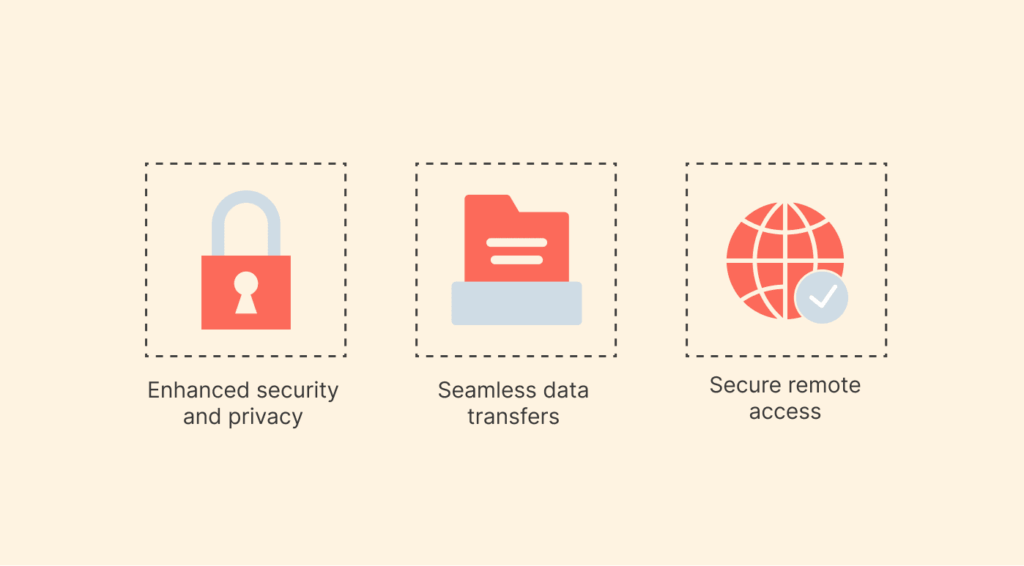
Common advantages of adopting a P2P VPN include the following:
Enhanced security and privacy
By connecting endpoints directly, you remove some intermediaries, reducing the number of places data can be intercepted. A VPN layer adds encryption and helps obscure each participant’s identity while in use.
Seamless data transfers
When data doesn’t need to flow through a single server, P2P setups can offer quicker, more efficient transfers for certain workloads. Many providers also run P2P-optimized endpoints to maximize throughput for large-file exchanges.
Secure remote access
P2P VPNs let you reach and manage remote machines securely without relying on centralized infrastructure, hosting the necessary networking logic across peers instead.
Better privacy
Traffic that travels peer-to-peer tends to be less centralized, making it harder for outside observers to map your activity. P2P VPNs conceal traffic details such as source and destination, though weaknesses in devices or peers can still be exploited.
Bypassing censorship
Unlike traditional VPNs, P2P VPNs distribute traffic across many nodes, which can complicate attempts to block or throttle connections. Still, sophisticated DPI systems may detect and block some P2P VPN traffic.
In practice, P2P VPNs operate locally across the network rather than relying solely on a provider’s public server list, and that distributed nature can draw less attention from simple VPN-detection tools.
Difference between a P2P VPN and a commercial VPN
FAQs
Can P2P activity be traced?
Many P2P VPNs route traffic through several nodes so no single node sees both ends, which makes tracing users more difficult but not impossible in all scenarios.
Do P2P VPNs improve download speeds?
Not necessarily. A P2P VPN can introduce some latency and throughput limits, and performance often depends on the hardware and availability of participating nodes.
Do P2P networks need special software?
Yes. You’ll typically use dedicated P2P clients or dVPN apps to discover peers and exchange data. Examples include popular BitTorrent clients, decentralized VPN applications, and distributed storage tools.
Can my IP leak while using a P2P VPN?
A properly configured P2P VPN hides your IP address from other peers, but leaks can occur if the VPN is misconfigured or privacy options are disabled.
Do all VPN services support P2P?
No. Some providers restrict peer-to-peer traffic to specific servers or don’t allow it at all. Always confirm P2P support before subscribing.
